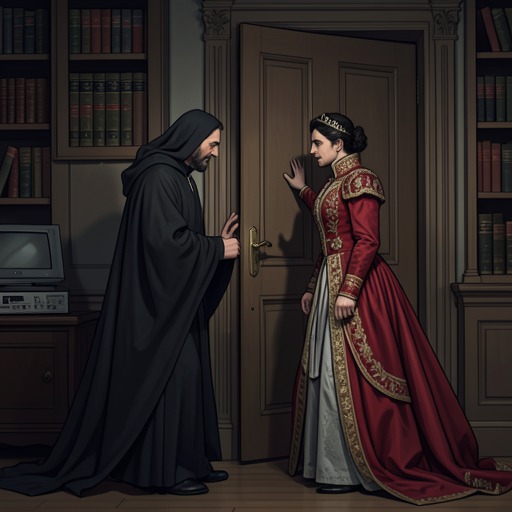
Marriage of Arthur, Prince of Wales, and Katherine of Aragon
The King's CurseThe marriage of Arthur Tudor, Prince of Wales, and Katherine of Aragon was a dynastic union whose preparations and early arrangements were overseen in part by Margaret Pole. Its political purpose was visible in the public display of a new Tudor generation, while its later significance rested on a private question that Margaret could not settle: whether the marriage had been consummated.
Preparations in London
In autumn 1501, after Katherine had reached the age of fifteen, Margaret travelled to London with Arthur and his mother. For two months they arranged the young prince’s wardrobe and wedding clothes, directing tailors, jewelers, glove makers, hatmakers, and seamstresses. The scale of the preparations made the marriage a public royal occasion even before the bride arrived.
Arthur was nervous and had written regularly to Katherine in Latin, the only language they shared. Elizabeth of York urged that Katherine be taught English and French, worrying that the couple could not speak together without an intermediary. Margaret answered that Katherine would learn the language and customs of her new home. Their exchange placed the practical difficulty of the match beside its political ceremony: the marriage joined two royal households, but the bride and groom began as strangers who could not converse in their own languages.
Receiving the bride and preparing Ludlow
When Margaret first met Katherine at Ludlow Castle, she saw a slight, carefully dressed young woman whose reserved manner gave way to a shy smile when she looked up. Margaret welcomed her in Latin. Katherine, anxious and looking for Arthur, began by expressing sympathy for the death of Margaret’s brother, touching on a family loss that Margaret would rather not have been reminded of.
Margaret had travelled ahead of the couple to make Ludlow ready for their arrival after the wedding. The king had ordered that they go there without delay, a journey of nearly two hundred miles from London in severe winter weather. Katherine would have to leave most of her Spanish companions behind and exchange the comfort of home for an unfamiliar castle. Margaret’s preparations were therefore not simply ceremonial: servants cleaned the rooms, rich tapestries were hung, carpenters worked to reduce draughts, and new curtains and linen were ordered. She also arranged a large barrel, sawn in half, to serve as a bath, and laid fresh herbs in the rooms. The king wanted the journey to display the next generation of the Tudor line; Margaret’s work attended to the young bride who had to make that journey.
A dynastic match under pressure
The marriage carried meaning beyond the couple. Margaret described Edmund de la Pole, a kinsman serving Henry VII, as a visible sign that a Plantagenet could occupy a place at the Tudor court. She also recalled a broader web of cousins and relatives whose blood and marriages linked them across England. In that political landscape, Arthur and Katherine’s union belonged to a royal strategy of continuity, while Margaret’s family ties made her both a participant in court life and a person exposed to its suspicions.
The strain surrounding the marriage became sharper after Arthur’s death. In a later confrontation, Margaret Beaufort demanded that Margaret confirm that Arthur had been taken to Katherine’s room every week, as ordered. Margaret acknowledged that the arrangement had been carried out. Margaret Beaufort treated the visits as evidence against Katherine’s claim that the marriage had never been consummated and accused Margaret of supporting that claim. The account establishes the regular visits and the accusation, but does not resolve the contested question of consummation.
Aftermath and disputed meaning
The uncertainty mattered because Katherine’s account of her marriage to Arthur bore on whether Henry VIII could marry his brother’s widow. Margaret Beaufort argued that a papal dispensation could permit such a marriage if Katherine continued to say that her first marriage had not been consummated; she regarded Katherine’s claim as a lie and Margaret’s support as a threat to her son and household. The marriage thus became more than a past union: its disputed circumstances were invoked in an argument over the validity of a later royal marriage and the future of the Tudor line.
The wedding’s public preparations and the move to Ludlow presented the couple as the next generation of the monarchy. In retrospect, however, the account turns on the limits of what ceremony and family testimony could establish. Margaret could describe the preparations, the journey, and the weekly visits; those facts did not end the dispute over what the marriage had meant in private.